NIKO KETO, USITOE MAFUTA
Korir Cherinyit
Monday, 17 August 2026
How to Read a Steak—Kenyan Style
Most people cannot read a steak, which is why they keep buying the wrong one. In butcheries and supermarkets across Kenya—from Eldoret to Nairobi, Mombasa to Kisumu—you’ll see beautiful cuts trimmed until they’re lean and polite, then wonder why they taste like nothing and leave you hungry two hours later.
At Keto Diet Champions & Wellness Centre, we teach you to read beef the way our ancestors did: by honouring the fat. Because flavour, fullness, and metabolic health live there—not in the lean.
*
Read It in Three Places (in This Order)
1. The Cap
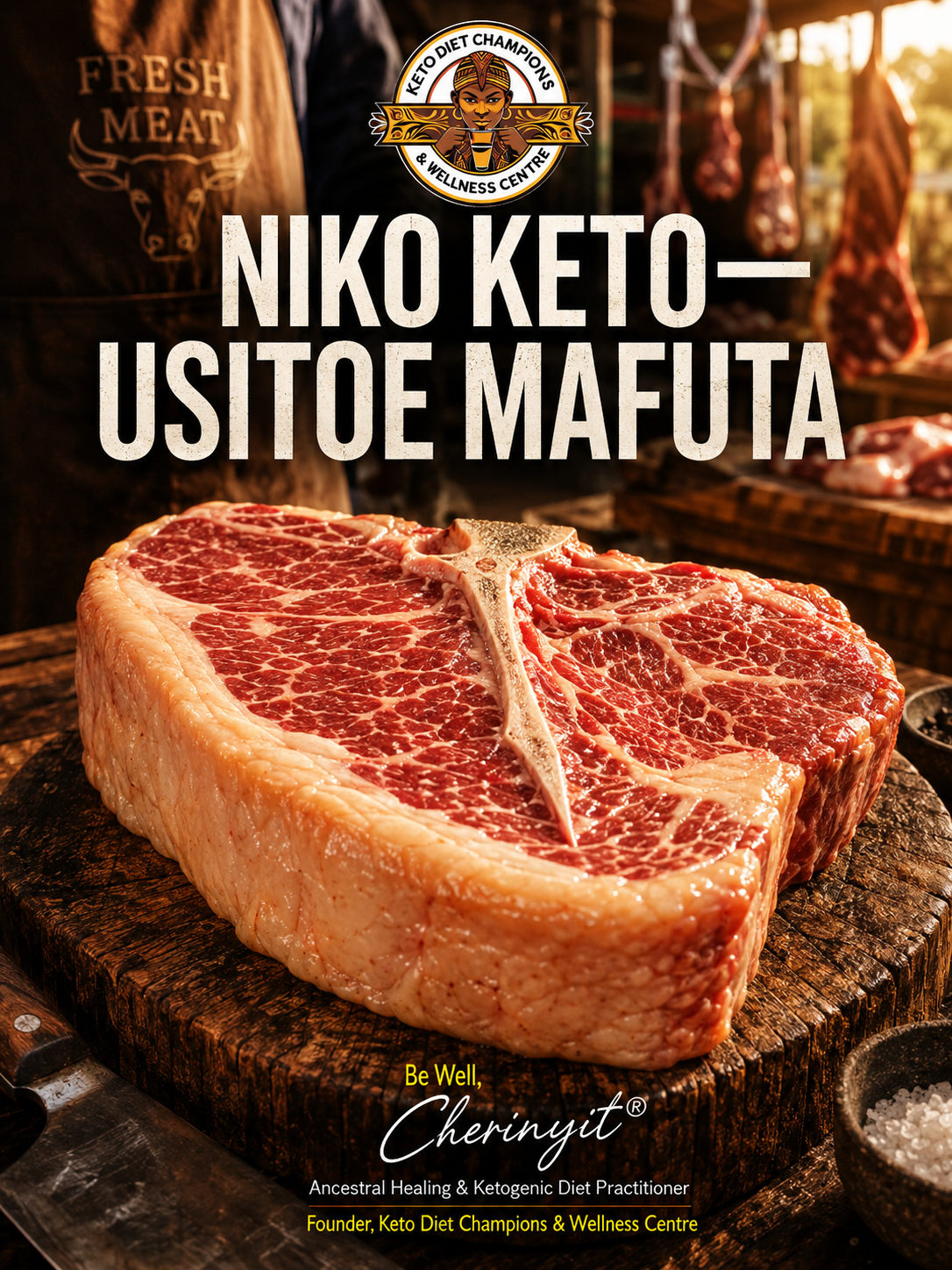
That thick band of pale fat curving round the outside edge, running the full length of the cut. Buy it for that alone. As it renders, it bastes the meat from the outside in—and if your sufuria, grill, or jiko is hot enough, it crisps into something close to nyama choma crackling.
Yet it’s the first thing a nervous shopper asks the butcher to cut away. That’s how a good steak gets ruined before it leaves the counter.
2. The Seams
Those wide white rivers running through the middle, dividing one muscle from the next. That’s the spinalis separating from the eye—and the spinalis is the finest piece of beef on the animal. Cut it away, eat it on its own, and you’ll understand why butchers quietly keep that bit for themselves.
3. The Marbling
The fine web threaded all the way through the red, like frost on a window in January. That fat sits inside the muscle, so it cannot be trimmed off and it cannot leak away. It melts as the steak cooks, from within—and it’s the entire reason a ribeye is juicy while a fillet is merely polite.
*
Why Fat Is Medicine (Especially on Keto)
*
What to Look For at Your Local Butcher
This one has all three markers: cap on, seams open, web running edge to edge. Most of what sits in a supermarket chiller or local butchery display has a shaved cap, thin seams and almost nothing running through the middle.
Even a good fatty cut comes in at about 1.2 grams of fat to 1 of protein, which is barely over the line for keto. So finish it in butter anyway: fifty grams in the pan at the end, off the heat, spooned over until the whole thing is glossy.
Then eat it slowly—because you will not want anything else for the rest of the day, and that is the point.
*
Local Keto Tip: Ask Your Butcher for “Fat-On” Cuts
In Kenya, many butchers default to trimming fat because they assume customers want lean. At your local butchery, ask specifically for:
Tell them: “Niko keto—usitoe mafuta.” (I’m on keto—don’t cut the fat.)
*
Want a Keto-Friendly Steak Guide for Kenyan Cuts?
Drop a comment or DM us. We’ll share a simple visual guide showing which local cuts to choose, how to cook them in butter, ghee, or coconut oil, and how to pair them with traditional indigenous vegetables and tubers like nduma (arrowroot), cassava (in moderation), sukuma wiki, cabbage, or terere for a complete ancestral keto plate.
Keto Diet Champions & Wellness Centre
Based in Eldoret. Serving Kenya.
Ancestral wisdom. Metabolic health. Kenyan roots.
Be Well,
Cherinyit®
Ancestral Healing & Ketogenic Diet Practitioner
Founder, Keto Diet Champions & Wellness Centre
Ready to Start?
Book a consultation today
Take the first step toward your health transformation with a KSh 300 consultation.
Book Now →